Friday, 6 June 2008

Shabbat candles in the summer


Why

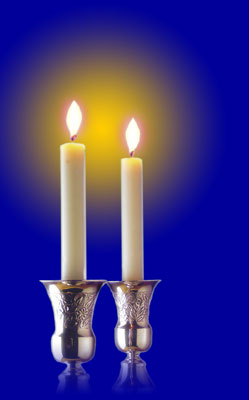
'Candle lighting time' is a phrase that is familiar with starting Shabbat. We light candles so that we have light in the home on Shabbat.

When
Shabbat, of course, can only occur on Shabbat. You could not bring in Shabbat on a Tuesday, for instance. Therefore, there is an earliest time that Shabbat can begin on Friday. That time is called 'Plag HaMincha'. It changes each week just like the Shabbat time changes each week since the Jewish legal clock runs according to the hours of daylight for these purposes. The latest time for lighting Shabbat candles is the published time that Shabbat starts, other than in the summer as will be explained below.

Accordingly, the time that appears during the summer as 'earliest time for candle lighting' on the shul website or in the Shmaltz newsletter is the time of Plag Hamincha, the earliest time that Shabbat can start and the earliest time that Shabbat candles can be lit.


Summer Living

In the summer, many communities have the custom of bringing in Shabbat early, i.e. after Plag Hamincha, so the earliest time is most relevant at this time of the year. To avoid confusion and promote unity, individual members of a community must follow the community's lead and bring in Shabbat early.


Accordingly, the time listed on the shul website or in the Shmaltz newsletter as the 'latest time for candle lighting' is the time that community brings in Shabbat. This is the time that Shabbat starts in the South Hampstead community. The statute book source for this is in the Shulchan Aruch , section Orach Chayim , 263:12.


What happens when Friday services start before Plag Hamincha and you want to go to Shul?


1. If you are the only occupant of your house and are eating at home on Friday night then you should not light candles before going to Shul. Instead, leave lights on before you leave home and when you come back from Shul, these lights will fulfil your obligation to have light in the home on Shabbat. Use of a timeswitch is recommended.


2. If you are the only occupant of your house and eating elsewhere on Friday night then your obligation to have light on Shabbat is 'covered' by the candles of the home where you will eat although leave lights on in your own home for Shabbat if you wish, as in section 1 above.


3. If you are going to shul but somebody else will is staying in the home then the person staying at home (whether they are a man or a woman) should light Shabbat candles after Plag Hamincha but before the latest time for candle lighting published in the Shmaltz or on the shul website.


On holiday...
If you are in a different community for Shabbat, you should follow the custom of that community when you are there.


If you are in the middle of nowhere for Shabbat in a place with no Jewish community, use this site to find out when Shabbat comes in.

It worked for Llandovery when I was there for Shabbat last summer. It's one thing a Tom Tom does not do yet!


Shabbat Shalom

Thursday, 8 May 2008

Hallel on Yom Ha'atzmaut - how should I mark the day?


A number of people have asked about appropriate prayers for Yom Ha'atzmaut. Here are some brief notes.

It is very important to have hakarat hatov (gratitude) to G-d and to recognise the importance of Yom Ha'atzmaut, a day which marks the declaration of the State of Israel.

How can we express this?

If you can, try to have a seuda, festive meal. This does not need to be a visit to a restaurant! Buy and ice cream or a smoked salmon sandwich, for example, if that makes your lunch a bit more special! Food helps us to develop an internal appreciation of a special event.

Psalm 126 (the 'Shir hama'alot) before Birkat Hamazon (benching) was one of the candidates to be the Israeli national anthem. It is a very appropriate Psalm. Psalm 107 is in the same vein. The prayer for the State of Israel is also appropriate.
Hallel is also appropriate for Yom Ha'atzmaut. The green siddur notes that some communities recite Hallel with a beracha (blessing) whilst others do not. What is the reason for this non-prescriptive note?

Reciting Hallel and reciting a beracha are in fact two separate questions, none of which have anything to do in this context with negativity towards Zionism. They also give a glimpse into the methodology of Jewish law, which lawyers may particularly appreciate!


Saying a beracha
Based on the second of the 10 commandments, 'lo tisa' (do not take G-d's Name in vain), some Poskim (Halachic authorities / authorities in Jewish law) rule that if there is a doubt as to whether a beracha should be said in a particular situation, then the beracha should not be recited due to lo tisa.

To use a familiar example from this time of the year, if you are about to go to sleep are not sure whether you counted the Omer that night or not, you should count without saying the beracha. Why? If you already have counted, then saying the beracha again could be taking G-d's Name in vein as the counting is the actual mitzva and the beracha is just an introduction to focus you, so therefore you can perform the mitzva without saying the beracha.


Why might there be a doubt as to whether to say a Beracha for Hallel on Yom Ha'atzmaut?
The Talmud (Pesachim 117a) discusses when there is an obligaition to say Hallel. Various conditions must be fulfiled for Hallel to be said. For example, these conditions include whether a particular salvation took place on a particular day, how many people were saved, what the outcome of the salvation was.

It is noteworthy, for example, that we do not say Hallel on Purim. Amongst other reasons, the outcome of the salvation in the Purim story was that we were almost back to square 1, so to speak, since despite the salvation we were still servants of King Achashvairosh.

Applying the Halachic conditions of when to say Hallel to the facts of Yom Ha'atzmaut in 1948, it is hard to arrive at a definitive conclusion as to whether Yom Ha'atzmaut requires the recitation of Hallel or other prayers which may be more appropriate.


Some Poskim hold that Hallel should be recited with a beracha since they feel that all of the conditions are satisfied.

Others hold a 'middle position' that since we are not sure if Hallel should be recited, we can say it without a beracha (this is the position of the Chief Rabbinate of Israel). How does this work? The contents of Hallel are very appropriate Psalms which we can certainly say for Yom Ha'atzmaut and help us to acknowledge that it is a special day. Since we can say these Psalms without the beracha of Hallel (either at the start of the finish of Hallel), the beracha is not essential as in the example of the Omer above. By not saying the beracha, we avoid infringing lo tisa in case Yom Ha'atzmaut does not tick all of the boxes required for definately saying Hallel.


Conclusion
Regarding Hallel, each community should follow its own position based on a reputable Posek (singular of Poskim), as reflected in the non-prescriptive instuctions in the green Siddur. In South Hampstead, we follow the position of the Chief Rabbinate of Israel.
If you cannot say Hallel, try to eat something special for the day to try and develop an internal appreciation that this is a special day and say one of the Psalms linked above.
If you want to sing or listen to Hatikva (Israel's national anthem), look at this which is a stirring rendition. Hebrew words and translation are at the bottom of here. Transliteration is at point 3 here. Look here for a broadcast from 1948 in Hebrew including a short clip of David Ben-Gurion reading the declaration of independence.
For a great and detailed Yom Ha'atzmaut resource, go to Yeshiva University's resource pack here .
Chag Ha'atzmaut Sameach!

Thursday, 24 April 2008

The last days of Pesach

The end of Pesach – Why does Pesach last for 7 days (or 8 in the Diaspora)?

As we have previously discussed, the first ‘Pesach’ festival which the Jews observed in Egypt had two parts to it: 1. Chag (festival) HaPesach and 2. Chag HaMatzot, as described in Shemot (Exodus) chapter 12.
In the next chapter of Shemot (chapter 13), the Torah gives us details of how Pesach is to be celebrated in future years as a combination of both Chag HaPesach and Chag HaMatzot. This is therefore what we celebrate for Pesach. This combination is also reflected in the use of ‘Chag HaMatzot’ as the designation for Pesach in the Amida / Shemona Esray prayers for Pesach and in Birkat Hamazon (Grace after meals).

Pesach celebrates the Exodus but why though should it last for 7 days (or 8 in the Diaspora) rather than just marking the day when we actually left Egypt? We will look briefly at 4 of the many answers to this question.

One answer may be that the splitting of the Yam Suf (Sea of Reeds) happened on the 7th day after the Jews left Egypt, the 7th day of Pesach. However, this assertion does not appear in the Torah itself, rather being located in the Midrash (Rabbinic teachings ‘between the lines’ of the Torah).

Chizkuni (Rabbi Chezkia ben Manoach, 13th century France), in his commentary to Shemot 12:15, (explaining why the Torah states ‘you shall eat Matzot for 7 days’), suggests that the 7 days of Chag HaMatzot correspond to the 7 days which each of the 10 plagues lasted.

Rabbi Avraham Ibn Ezra, another of the great medieval exegets, offers a different suggestion. A close reading of the verses from Shemot 12:31-12:42 shows that the Jewish people ate Matzot during the days between the Exodus from Egypt and the splitting of the sea (see verse 39 in particular). The people took their left over dough when Pharaoh expelled them from Egypt and they used this dough to cook Matzot, perhaps because it was the food they were used to eating as slaves. They ate Matzot until the splitting and other miracles at the sea demonstrated the finality of the Exodus and the definite end of their slavery. R’Ibn Ezra’s point is backed up by pesukim (verses) in Devarim (Deuteronomy) 16 which further describe the obligation to eat Matzot.

Rambam (Maimonides aka Rabbi Moses ben Maimon), discusses this question in his Moreh Nevuchim (Guide to the Perplexed), 3:43 and offers another perspective. He writes that if the festival of Pesach, commemoration of the Exodus, eating of Matza (and the prohibition of Chametz) would only last for one day, then we may not fully appreciate their significance as this would not be a significant alteration to our schedule. (Consider this point in light of the length of the festival of Shavout / Pentecost).

To gain the appropriate appreciation of the festival of Pesach and its messages each year, we therefore celebrate Pesach for a more significant period of time, i.e 7 or 8 days.

What then about Chol Hamo’aid (the middle days of Pesach, the ‘sandwich’ in between Yom Tov at the start and the end of Pesach)? All being well, we’ll examine this another time.

Wednesday, 16 April 2008

Shemita Update 16 April 2008


Here is a link to the latest Shemita update from the London Beth Din.
If you are buying celery to use as Karpas as the Seder, check that you do not buy celery affected by the Shemita update.
(I'm planning on using celery as it is easy to wash and prepare than parsley, let alone the taste...!)

Monday, 14 April 2008

A Framework for the Mitzvot of Pesach

Pesach and Chodesh Nisan (Month of Nisan (Mitzvot)
A combined list of general Yom Tov and Pesach Mitzvot from the Torah, which apply today, according to the counts of the Sefer Hachinuch (book about the Mitzvot) and Rambam (the great Medieval scholar, Rabbi Moses ben Maimon, aka Rambam). Those mitzvot which are specifically for the Seder are in bold:

1.Getting rid of Chamaitz.
2.Eating the minimum amount of (shemura) Matza at the Seder night at night .
3.That Chamaitz should not be found in your possession on Pesach.
4.To get rid of chamaitz on 14 Nisan (Rambam) and neither to eat nor benefit from Chamaitz after the end of the 6th hour of that day. (see footnote 3)
5.Not to eat anything on Pesach that contains Chamaitz.
6.Not to eat Chamaitz on Pesach
7.Sipur Yetziat Mitzrayim – ‘Recounting’ (?) the Exodus from Egypt.
8.Not to perform Melacha[1] on the first (and second) day of Pesach.
9.Resting on the Seventh (and eight) day of Pesach.
10.Not to perform Melacha on the seventh (and eighth day) of Pesach.
11.Not to eat Chamaitz on Erev Pesach after chatzot.
12.To say whole Hallel on the first day of Pesach.
13.Lismoach, to ‘rejoice’ on Pesach.

List of Pesach, Seder and chodesh Nisan (month of Nisan) Mitzvot which are Rabbinically mandated[2] as a framework to fulfil the Torah mitzvot:
a. Ma’ot Chitin – Pesach charity
b. Beracha on fruit trees in blossom
c. Bedikat Chamaitz (searching for chamatiz), Biyur Chamaitz (getting rid of chamaitz), Bitul Chamaitz (disavowal of chamaitz). Mechirat Chamaitz (sale of chamaitz) if this is necessary in your circumstances.
d. Not to eat Matza on Erev Pesach (some have the custom not to eat Matza for a month before Pesach) to have a ‘taste’ for the Matza shel Mitzva at the Seder.
e. Not to eat Chamaitz on Erev Pesach after the start of the 5th hour of the day.[3]
f. Preparing for the Seder.
g. Four cups of wine ‘al haseder’ (in the designated order), including Kiddush.
h. Conducting the Seder after nightfall (may be understood as a Torah mitzva).
i. Hasaiba (recling), mandatory only for men.
j. Eating Maror.
k. Reciting Hallel
Other Mitzvot Related to Pesach and Chodesh Nisan (the month of Nisan):
Ta’anit Bechorim.
Chol Ham’oaid.
Sefirat HaOmer.

[1] Creative labour forbidden on Shabbat and Yom Tov (some specific Melachot (pl.) are ok on YT).
[2] Jewish law has a 3 tier structure – 1. Torah law (including the Oral Torah) 2. Rabbinic law (the Torah gives Rabbinic authorities a mandate to legislate to protect and maintain Torah law) 3. Custom (minhag) which is often using in the application of Rabbinic law, since in many circumstances the Rabbis gave a broad scope to their laws allowing for divergent applications within the framework of their laws. In a similar vein to clashes of legal principle in English law, the Rabbis in this case work on how to decide between conflicting principles of law.

[3] For such purposes, the Jewish clock runs according to the hours of sunlight each day as calculated from sunrise to sunset. See www.myzmanim.com for more on this topic.

Pesach Notes for People who cannot stay up for the Seder.

Some Notes on Making a Seder for people who cannot stay up for the Seder and for making a Seder for young children – London, 2008/5768

The General situation
When does the Seder start?
On both Seder evenings, the Seder starts after nightfall[1]. Nightfall for these purposes is the time of ‘tze’ait hacochavim’[2]. This year in London (2008/5768), the earliest time to start the Seder is at 8.56pm.

How does this impact on Seder preparations?
This year, Erev Pesach (Pesach eve) is on Shabbat 19 April. As Shabbat is a day dedicated to Shabbat only, no Pesach preparations take place on Shabbat. Pesach preparations are finished on Friday, other than really final preparations such as laying the table (if this is not possible before Shabbat) or taking out food once Shabbat has ended. Shabbat ends at 8.56pm.

At this time, say the phrase ‘Baruch Hamavdil bein Kodesh leKodesh’ (a mini form of Havdala) and then you can move into Seder mode, including warming up food for the Seder meal within the parameters for warming food on Yom Tov.

Eating Matza is the only Torah based eating mitzva of the year (believe it or not given all the jokes about Jews and food!).

Therefore, we should get Pesach and the Seder right, sticking to this structure.
------
The notes that follow apply only for people whose health will not allow them to participate in the proper structure of the Seder, or for young children who are unable to stay up for the Seder. They also pertain to those looking after people in ill health or young children.

People in poor health who cannot stay up for the Seder or have difficulty in eating Matza etc.

Shabbat 19 April and Sunday 20 April 2008

7.35pm[3]
Wash hands ‘Urchatz’; Eat a small amount of celery/parsley ‘Karpas’; Break the middle Matza and hide the larger half for Afikoman ‘Yachatz’.
Eat dinner whilst going through the ‘Magid’ section of the Hagadah, eg sing Dayainu!! Stop at the section beginning ‘Rabban Gamliel used to say’, which is close to the end of ‘Magid’.

8.35pm at the earliest
Recite Kiddush and drink the 1st cup as found at the start of the Hagadah (don’t worry, we’re not playing snakes and ladders so you don’t start the whole Seder again!).
Go back to where you left off before making Kiddush and continue with Magid from ‘Rabban Gamliel used to say’. Drink the 2nd cup and eat Matza, Maror, (if you are able to, eat ‘Korech’ as well), Afikoman. Say Birkat Hamazon / Bensching/ Grace after Meals.
Drink the 3rd cup of wine. Sing as much of ‘Hallel’ as you can and drink the 4th cup of wine.

This completes the Seder for people in poor health who cannot make the Seder at its proper time.

What about people whose health does not permit them to follow this schedule?
Start at 7.35pm as above. Matza may be eaten from 7.50pm but without making a beracha/brocha/blessing. The blessing can only be made after 8.35pm.
Stay up as late as you can and follow the instructions above.

How much Matza and grape juice should be drunk by people whose health makes it hard for them to eat and drink?

Matza
For each Matza eating, try to eat an amount of matza measuring 4 x 3 ½ inches.
If this is not possible, try to eat that amount for the first Matza eating and an amount equivalent to at least 5 grams for the other Matza eatings.
If this is not possible, eat one piece of Matza weighing at least 5 grams for the first Matza eating and at least 5 grams of Matza for as many of the subsequent Matza eatings that you can manage.
If you cannot eat Matza as it is, you can dip it into water to soften it.

Maror
If you can, eat either 20 grams of horseradish or Romaine lettuce measuring 10 x 8 inches. If you cannot eat this amount, then eat as much as you can but without saying a beracha/brocha/blessing on the Maror.

The 4 cups
Use grape juice if you prefer it to wine. Each cup should hold at least 86ml (that is less than half of a standard plastic cup so not very much liquid). Drink at least the majority of 86ml. Do not use leftovers from one cup for the next cup, instead pour out a fresh amount.
If you cannot drink grape juice or wine, drink cups of tea of at least 86ml instead, prepared from a ‘Shabbat urn’ which you filled before Shabbat started (as Shabbat this year is Erev Pesach). Unlike on Shabbat, the urn can be topped up on Yom Tov.


General Points

If you are helping somebody whose health compels them to begin the Seder early, you can join in the songs and discussion with them but you should not start the Seder yourself until nightfall as defined above.

If you need to care for a person in poor health at the same time as you participate in the Seder, make sure that minimally you drink the 4 cups in their proper order, say the major parts of ‘Magid’ (i.e. at least Ma Nishtana, Avadim hayinu, the 4 sons, ‘Rabban Gamliel used to say’ until the end of Magid), eat Matza, Maror, Korech and Afikoman. If possible, share the responsibility with another Seder participant.


Young Children who cannot stay up to participate in the Seder

- Make a mini-Seder for the children
- Depending on the age of the children, start as close as you can to nightfall.
-Involving your children, if possible, get a mini-Seder table ready.
-Sing songs and play Seder games with your children, discuss the story of the Exodus from Egypt and let them present any notes about the Seder that they may have prepared at school or at Cheder.
-Select one section of the Hagadah to discuss with your children.
-Give them some Matza and some lettuce for Maror and then follow that with their supper so that you give them as mini-Seder which is as close as possible to the real thing.
-It is important to understand the Magid section of the Hagada in particular and so read and discuss that in English except for the Berachot/Brochas/blessings.

If you have any questions, please email me


Chag Samayach! Have a Happy Festival of Pesach


[1] Since the Jews left Egypt on the night of 15 Nisan, which is the first night of Pesach (see Shemot/Exodus 12:8). Also see Shulchan Aruch OC 472:1. TB Berachot 27b, Pesachim 120b.
[2] Lit. the coming out of the stars. Often referred to as ‘3 stars’.
[3] As noted above, the Seder must begin at night. The earliest definition of ‘night’ in Jewish law is a time called ‘Pelag Hamincha’. This definition is a minority opinion in Jewish law. In a situation such as a person in poor health who cannot make the Seder at the right time, the minority opinion may be relied upon.

Wednesday, 9 April 2008

Pesach 5768 / 2008 - Preparation and Seder guides


Until I can figure out how to upload them, email me for some of the Shul's Pesach guides for this year!

Information on the Seder material is summarised in tables for ease of reference (I hope!)


  • Mitzvot of the Month of Nisan.

  • Mitzvot of the Seder.

  • General Pesach Preparations, including notes for this year when Erev (eve) of Pesach is on Shabbat.

  • Kitchen and house preparations.

  • Timetable of Services and detailed information about Erev Pesach on Shabbat and Pesach logistics.

Tuesday, 18 March 2008

The Mitzvot (Obligations) of Purim: A brief guide


Fast of Esther (Thursday 20 March 2008) starts 4.24am, ends 6.54pm. For info on the Fast of Esther, please see here


For more in-depth Purim Info see here.

Megila
The Megila (Scroll of Esther) is read on Purim evening and Purim day. It tells of the salvation of the Jews on Purim and explains the basis of how we celebrate Purim. Those who wish to fulfill this obligation correctly listen to every word of the Megila.

Purim Seuda (meal)
We celebrate Purim with a festive meal during the day (this year on Friday). As this year Purim is on a Friday and we also need to prepare for Shabbat, start the Seuda by midday and wrap it up by 5pm at the latest (Shabbat starts at 6.01pm, which is the latest time for candle lighting and the time the service starts in Shul). The meal is enhanced by wine to celebrate the miracles of our salvation on Purim. There are plenty of urban myths about Purim and drinking. Jewish law (halacha) mandates that you follow the instructions on whisky bottles and drink responsibly.

Mishloach Manot
Literally, the sending of gifts. Give at least two different ready to eat foods, eg a tub of chumus and a packet of crackers to another Jew. We give gifts to show our gratitute at the Purim salvation.

Matanot Le'evyonim
Literally, charity to those who need. More should be spent on this mitzva than Mishloach Manot. This money should reach its recipients on the day of Purim. Collection boxes will be available in Shul and the proceeds will be distributed on the day of Purim to help needy families celebrate Purim.

If you have any Purim questions, please email me.

Sunday, 16 March 2008

Shemita Update March 08/Adar 5768

Here is a link to the latest Shemita update from the London Beth Din's Kashrut Department.

http://www.kosher.org.uk/shemittaalert.htm

Israeli chocolate is fine though as cocoa beans are not considered to be fruit even if you might wish they would count as one of your 5aday!

Purim Sameach / Happy Purim

Sunday, 20 January 2008

Tu Bishvat / Tu B'shvat - the new year for trees

(see the late great Rabbi Shlomo Yosef Zevin's 'The Festivals in Halacha' for more information on Tu Bishvat. It is gratefully acknowledged for its use in preparing this post.)

This Monday night and Tuesday (21/22 Jan 08) is Tu Bishvat (aka Tu B'shvat). Tu Bishvat means 'the fifteenth day of Shevat'. The Hebrew letters 'tet' and 'vav' have the numerical value of 9 and 6 respectively and Shevat is one of the months of the Jewish calendar.

Tu Bishvat is mentioned in the Mishna (Rosh Hashana 1:1) as the new year for trees. According to the Beit Hillel (house of the sage Hillel), the new year for trees is on 15 Shevat whilst according to Beit Shammai (house of his great contemporary Shammai), the new year for trees is on 1 Shevat. The Gemara (Rosh Hashana 14b) decides in favour of Beit Hillel as it usually does in disputes between the two houses.

Why is there a new year for trees and why is there this difference of opinion as to when it occurs? (this is not to do with when it is most convenient for school kids to be able to plant trees or flowers to celebrate Tu Bishvat - so I am told!!)

The signifcance of the new year for trees lies primarily in various laws in the Torah that apply to trees. It is similar to the need for a financial new year for laws for laws which apply to appropriate money laws.

An example of the law that applies to trees is called 'orlah'. Orlah is a mitzva which prohibits using the produce of a tree in its first 3 years. The first year for this purpose ends on the Tu Bishvat following the planting of the tree.

The disagreement as to when the new year for trees occurs is based on disagreements as to when most of the rainy season has passed and when trees will then grow faster again (see the commentaries of Rashi and Tosafot on the Mishna that we cited). The Sages wished to get this time as right as they could.

Tu Bishvat has particular application in a Shemita year (see these posts for an explanation of Shemita) as it helps to distinguish between fruit which is part of the Shemita year and that which is not.

Since most of the laws relating to Tu Bishvat concern mitzvot hateluyot ba'aretz (Torah laws which apply only in the Land of Israel), it is a day which has more application in Israel than in the Diaspora. Nonetheless, it is a day which reminds us that the Torah directs us as to how to care for trees and by extension the rest of the environment and should make us pause to consider these ideas (get your recycling ready now!)

Some Sepharadi Jews, basing themselves on mystical sources, say special prayers, sing special songs and make a special feast for Tu Bishvat at which they eat as many different kinds of fruit as they can.

Ashkenazim, according to the Magen Avraham, (Shulchan Aruch, Orach Chayim 131:16) also eat many kinds of fruit - some people go for 15 since Tu Bishvat is on the 15th day of the month - but without the same kind of celebrations that are customary in Sepharadi communites, although the Ashkenazim cheer themselves by reciting Tachanun neither on Tu Bishvat nor at Mincha of the preceeding aftenoon.! (see Shulchan Aruch, Orach Chayim, 131:6)

Amongst Chasidim, many have the custom to pray on Tu Bishvat that they should get a beautiful etrog at Succot.

Whatever you do on Tu Bishvat, enjoy some fruit (if you buy Israeli fruit, make sure it is not Shemita produce - see here for info), consider the lessons of the day and look forward to the spring if you prefer it to winter!

Monday, 14 January 2008

Solar and Lunar Calendars

Following Rabbi Shlomo' sermon last Shabbat which dealt with why fixing a calendar is the first Mitzvah taught in the Torah and how the lunar (Jewish) calendar interacts with the solar (secular) calendar, Raphael Langham kindly sent me the following notes:

1. Judaism isn't the only religion that has a lunar calendar adjusted to the solar one. Burmese Buddhism (and probably other branches as well) uses one. They have twelve months each of 28 days and every few years an extra month is added to keep sync. with the solar calendar so that religious festivals are at much the same time each year. Interestingly the extra month has the same name as the previous one but with the number 2 (or the Burmese equivalent of sheni) at the end.

2. I hope it works better than ours. In 20,031 (Gregorian) 23792 (Jewish) Yom Kippur falls on Christmas day. Only just over 18,000 years to go, I just can't wait!

3. One should always try to work by the precept 'The best is the enemy of the good'.

Tuesday, 18 December 2007

Asara BeTevet - the fast of 10 Tevet


This Wednesday, 19 December 2007, is the fast of 10 Tevet.
What

The Talmud (Rosh Hashana 18b) describes the 4 of the Rabbinically instituted fast days in the Jewish calendar. These are based on the statement of the prophet Zecharia/Zakaria (8:19). The fast not mentioned in Ta'anit Esther/the Fast of Esther, whose source lies in the Megila.

One of the fasts menionted by Zecharia falls on 10 Tevet and is known as 'Asara BeTevet' which is the Hebrew phrase for '10 Tevet'. As with the other fasts, it is linked to the destruction of the First Beit Hamikdash / Temple, specifically commemorating the first breach in the walls of Jerusalem. You can find some of the details of the destruction in Melachim Bet / 2 Kings, chapter 25 which is the last chapter of the Sefer Melachim/the Book of Kings. Sorry for readers from Essex that there is no Seven Kings!

Why

You may ask why we observe Asara BeTevet. Like any other fast, abstinance from food and drink is meant to focus our minds on events. Not only was the destruction of the First Beit Hamikdash a tragedy that still affects Jewish life today, but the events around the destruction sound a salutary warning which should help us to avoid making similar mistakes as those made by our ancestors.
Rambam in his magnum opus "Mishneh Torah" (Hilchot Ta'aniyot / Laws of Fasts 5:1) writes that any calamitous events should engender a stocktaking, which we can suggest should be both personal and national. Furthermore, a fundamental part of being Jewish is identifying with other Jews rather than living as in isolation. A Jew cannot absent him or herself from the Jewish community, to avoid celebrations or, G-d forbid, hard times.

These are some of the reasons that the Rabbis saw as important in Asara BeTevet.

This year's times of the fast and who should not fast

This fast runs from dawn to night (in London for 2007, the fast starts at 6.12am and ends at 4.41pm). Eating and drinking are the only specific prohibitions. Although this is a serious day, it is minor in comparison with the two most serious fasts which are Yom Kippur and Tisha B'Av.
Accordingly, somebody who cannot fast for medical reasons, or who may become ill from fasting (such as a pregnant or nursing woman) should not fast although they should not choose this as the day they finally make that amazing stake mignon for lunch!

You'd never believe it but...

Given the specific wording used in Zecharia to describe Asara BeTevet, it cannot be postponed to another day and is the only fast, given the structure of the Jewish calendar, which can fall on a Friday! That is good trivia next time you are doon the pub!

Conclusion

Even if you are not fasting, it is important to take some time out on Asara BeTevet to ponder the significance of the day.

In modern times, the Israeli Chief Rabbinate has declared Asara BeTevet as 'Yom HaKadish Hakelali' - a Yartzeit day for victims of the Holocaust whose date of death is unknown.

Have a meaningful and easy Asara BeTevet.

Sunday, 16 December 2007

Shemita 3 - how does a modern economy deal with a Sabbatical year and latest product buying update

As we discussed in the first Shemita post, this Jewish year is a Sabbatical year (Shemita) for the Land of Israel. The Shemita year comes round every 7 years. It affects farmers and consumers in Israel and consumers outside of Israel as we will explain. It also affects the laws of loans but since that is not relevant until closer to the end of the Jewish year, we will focus on what is relevant now.

Here are some brief notes.

What is the source and what does the Sabbatical consist of?
The Torah, in Vayikra/Leviticus 25:4-6 and Shemot/Exodus 34:21 lists various categories of agricultural activities which are proscribed during the Shemita year. Briefly defined, these are sowing, harvesting, pruning and reaping. This also includes flowers.

The Torah also says that the Shemita year is a 'Shabbat for the land, for you to eat'. The Mishna (Rosh Hashana 22a / 1:8) derives from this while produce that grows by itself can (or even perhaps should) be eaten, trading this produce for profit is forbidden.

The Mishna rules that somebody who trades in Shemita produce is even disqualified as a witness in certain fields (ho ho) of Jewish law.

Some background
Sefer HaChinuch, a book about the 613 mitzvot, writes about Shemita in Mitzvot 326 and 84. Briefly stated, he explains that the Shemita year is a time to renew our appreciation of the natural world and G-d's control of it, without us dominating it. It is a kind of year long Shabbat (perhaps a reason for the Torah describing Shemita as a 'Shabbat for the Land' and a 'Shabbat for G-d'.)

Just like on Shabbat we rest from dominating the world and show our belief that G-d is in charge, so too in Shemita we rest from our physical domination, concentrate on spiritual ideals and show our belief that G-d is in charge. The Torah promises that the Land will produce enough produce to help the people through the Shemita year.

How is Shemita observed in a modern economy?
A modern economy poses many challenges for Shemita. Here are some of the solutions.

Heter Mechira (selling the land to a non-Jew)
Whoa! selling the Land! This is probably the most controversial of the solutions. Firstly because it is not at all clear if the Land of Israel can be sold to non-Jews and secondly because it is not clear if this is an appropriate way to act in the Shemita year.

The main halachic basis of the Heter Mechira is the judicial opinion given by the great 16th century authority, Rabbi Yosaif Karo, author of the Shulchan Aruch, that land in Israel owned by non-Jews is not subject to the laws of the Shemita year.

The historical origins of the Heter Mechira are in the Shemita year of 1888-9. A small group of religious farmers in Israel (this obviously is way before the State of Israel) asled Rabbi Naftali Hertz, the Rav of Yafo/Jaffa if they could sell their land to a non-Jew prior to the Shemita year, akin to selling Chameitz before Pesach, to save them from economic ruin. Rabbi Hertz consulted with the famed Rabbi Yitchak Elchanan Spector of Kovno, probably the highest ranking Poseik in Europe.

Rabbi Spector, in the face of some opposition, allowed the farmers to sell the land to a non-Jew for that Shemita year only due to the great economic hardships that the farmers faced.

However, due to severe economic hardships in subsequent Shemita years, the Heter Mechira has been invoked each Shemita year since then by some Rabbis who felt it appropriate, in the face of oppostion from those who disagreed.

Famous proponents of the Heter Mechira have included Rabbi Avraham Yitzchak HaCohen Kook and Rabbi Chaim Berlin. The official policy of the Chief Rabbinate of Israel is to use the Heter Mechira, although there is still debate as we speak as to the validity of their position.

Despite the controversey of the Heter Mechira and the fact that it seems to bypass some of the goals of the Shemita year - be they environmental, religious or social - it is the best way to allow all farmers in Israel, however religious they are, to maintain some level of Shemita observance.

It also allows Israeli consumers to maintain some level of Shemita observance and is cannot compare to those farmers who simply ignore Shemita .

In addition, it helps these farmers to keep their hard won export markets. Another benefit of the Heter Mechira is that it helps those suffering from poverty, one of the principle reasons that Rabbi Spector allowed the Heter Mechira initially.
Otzar Beit Din
As we mentioned above, trading Shemita produce for profit is prohibited. The Otzar Beit Din is a device which declares all fields ownerless and under the control of a specially constituted Beit Din. This Beit Din appoints collectors to gather the produce that grows in the fields, bring the produce to a central location and sell them at the cost that it took to get the produce to the distribution centre. Therefore, there is no trading for profit.

This is a well accepted method of keeping Shemita. It allows farmers to keep the laws of Shemita in all its aspects and supply food for the population. In addition, any food collected by the Otzar Beit Din has Kedushat Shevi'it (explained in the middle of the link), which some judicial opinions see as a Mitzva to eat. However, since food with Kedushat Shevi'it must be consumed within the Land of Israel, Otzar Beit Din produce cannot be exported.

Non-Jewish Produce
The final way to observe Shemita is to rely on the opinion of Rabbi Yosaif Karo stated above and buy non-Jewish produce.

Shutting down of farms
Some farmers shut down farms.

Where does Shemita apply?
Shemita only applies within the Biblical borders of the Land of Israel. These are somewhat different to the borders of the State of Israel. Since Eilat and part of the Negev desert are outside of these borders, the laws of Shemita do not apply to these areas.

CONCLUSION
How does the agricultural side of Shemita affect us in London?
Each of these methods of keeping Shemita in a modern economy have their pros and cons. We could suggest that full observance of Shemita in a modern economy is a Mitzva that still requires further thought. To quote the renowned Rabbi Dr Aharon Lichtenstein in this important article, each Shemita cycle he feels caught 'between the hammer and the anvil' (Rabbi Lichtenstein has a Phd in English literature from Harvard - I would never have thought of that phrase!)

The food aspect of Shemita only affects us in the supermarket. Look here for the London Beth Din's Shemita advice in both update 1 and update 2 which are on the same page - this advice details how those who wish to observe Shemita in the UK should procede. Buy the Israeli produce that is permitted - this is a Mitzva - but do not buy that produce that may or does contravene Shemita.

The Heter Mechira is controversial, as we have discussed. If one does not need to rely on it, it would seem better not to and this is the position of the London Beth Din as shown at the links above.

The buying power of the London Jewish community does not affect Israel's market share of Shemita products. We should buy Israeli goods when they are permitted. This also show our support to those who observe Shemita as do charitable donations to support farmers who observe Otzar Beit Din or shut their farms.

Even though we do not observe Shemita in an expansive way in the Diaspora, the social, environmental and religious lessons should not be lost on us. Perhaps we should make sure to reflect this in our weekly observance of Shabbat.

If you have any questions please email me.

Friday, 14 December 2007

A-Z Jewish Terms and pronounciation - Work in progress

Rabbi Hyman Krustofsky and his son, Krusty the clown from The Simpsons, third season.


Have you ever been stuck over a Jewish word or confused by a word you hear in Shul or elsewhere? Here is a guide to how to talk the Jewish talk. It is work in progress, so if you do not find the word you are looking for, please email me and hopefully I'll know what it means!


If you see a word which you do not understand that is used to explain a term, look for that word's entry in the list.

Here are a few general notes and pointers for understanding some aspects of Hebrew pronounciation.

Hebrew nouns and adjectives are either masculine or feminine. Masculine plurals end in '- im'. Feminine plurals end in '- ot' for Ivrit (Modern Hebrew ) or Sepharadi pronounciation. Alternatively, plural end in '-os' for Ashkenazi pronounciation. See, you already have two terms!!
'Ch' is pronounced as a gutteral, as in 'loch'.
The 'T' shaped Hebrew vowel is pronounced 'uh' in Ivrit and 'oh' in Ashkenazi pronounciation.
Examples
1. If an adjective or noun ends with the letter Tav, then it is pronounced 't' in Ivrit/Sepharadi and 's' in Ashkenzai. For example, Simchat Torah/Simchas Torah.
2.The word Shabbat/Shabbos is a singular feminine and ends in '-os' despite this. Therefore the plural is Shabbatot or Shabbosos.

In the following list, plurals are in (brackets) and written with Ivrit pronounciation. When Ashkenazi pronounciation is commonly used, it is written alongside the Ivrit pronounciation. Please contact me if you have any questions or want to read them with Ashkenazi pronounciation and need some help:

A
Aliya/ot - literally means 'going up'. Refers to call-ups to the Torah and also to going to live in Israel.
Anim Zemirot - a special responsive song recited on Shabbat and Yom Tov in many communities, often sung by a young boy.
Aron Hakodesh - the Holy Ark. This refers to the Ark in the Shul which holds the Sifrei Torah and also refers to the Aron (Ark) in the Mishkan described in the Torah.
Aveil (im) - a mourner.
Aveilut - being in mourning.

B
Bedikat Chamaitz - searching for Chamaitz before Pesach.
Beit Hamikdash - the two Temples that stood in Jerusalem.
Beit Knesset - Hebrew term for a Synagogue/Shul.
Beit Midrash - Study room, sometimes also used for prayer services.
Bima - the platform in a Shul, often where the Chazan leads prayers and where the leining takes place. In some shuls, the Chazan leads prayers from a different location.
Brit Mila/Bris Mila - circumcision. See here for more information.

C
Chazan - cantor, leader of communal prayers.
Chumash - Pentateuch, 5 Books of Moses.
Chupa - marriage canopy. Also used colloquially to refer to the whole wedding ceremony.

D
Daven - Yiddish word for prayer or praying. Sometimes anglicised to 'davening'.
Dinim - laws.
E
Eid(im) - religiously competent witnesses for certain ceremonies and for executing some commercial deals in Jewish law.
Eirusin- the first part of the marriage ceremony, the betrothal, which concludes with the giving of the ring.
Erev- the eve, such as Erev Shabbat=Friday.
Eruv/Eruv Chatzairot - an area in which items may be freely carried in the street on Shababt. Without such an Eruv, items may not be carried from one domain to another on Shabbat.

F
Frum- Yiddish for piety, religiousity.

G
Gabbai - voluntary warden of a Shul, an administrator; a administrator of charitable funds.
Gelila - rolling and dressing the Sefer Torah after Hagbaha.

H
Halacha/Halocho - Jewish law.
Haftara/Haftora - a reading from one of the books of Nevi'im to supplement the leining on Shabbat or Yom Tov.
Hagbaha - lifting up the Sefer Torah after the leining.
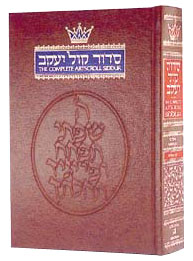
Havdala - short ceremony marking the end of Shabbat or Yom Tov. Either Havdala or a verbal proforma that Shabbat or Yom Tov has ended - 'Baruch Hamavdil bein Kodesh leChol' must be made to end Shabbat or Yom Tov. See page 608 in the green Siddur and page 618 in the Artscroll Siddur.

I
Ivrit - modern Hebrew, as opposed to Biblical Hebrew.

J

K
Kashrut/Kashrus - relating to kosher food; describes how something is suitable.
Keriat HaTorah - the reading of the Torah, aka leining.
Korban(ot) - a sacrifice.

L
Leining - a Yiddish word to for Keriat HaTorah, the reading of the Torah.
Luach - a calendar
M
Maariv - the evening prayers
Mincha - the afternoon prayers
Mohel - the person who performs Brit Mila. See here.
Musaf - Literally means 'additional'. An additional prayer recited on Shabbat, Yom Tov and Rosh Chodesh. A special korban was offered on these days in the Beit Hamikdash. After the destruction of the Beit Hamikdash, the Musaf prayer is recited instead.

N
Nevi'im - the books of the Prophets, the second part of the Bible. Runs from the book of Yeshoshua (Joshua) to the book of Malachi (Malachi).

O

P
Parasha (Parashat Hashavua) aka 'Sidra' - the weekly Shababt Torah reading; a 'parasha' also refers to one of the sections of the Parashat Hashavua.
Peticha/Pesicha- opening the Aron Hakodesh.
Parev/Parve - food which which is neither meat not dairy.

Q


R
Rosh Chodesh - the beginning of a new month in the Jewish calendar.

S
Sefer Torah - the Torah scroll containing the 5 books of Moses.
Seuda Shelishit - the third of the three Shabbat meals, eaten on Shabbat afternoon.
Sidra aka Parash/Parashat Hashavua - the weekly ShabbatTorah reading.
Shacharit/Shacharis - the morning prayers.
Shiur - Class or lesson.

T
Tanach/Tenach - an acronym of Torah, Nevi'im, Ketuvim which are the three sections of the Bible. This is the Hebrew phrase for the Bible.
Tefila(ot) - prayer.

U

V
W
X

Y
Yartzeit - the yearly anniversary of a deceased persons passing.
Z
Zeman - a time, such as the cut-off time for eating Chametz on Erev Pesach.

Tuesday, 11 December 2007

The last day of Chanukah


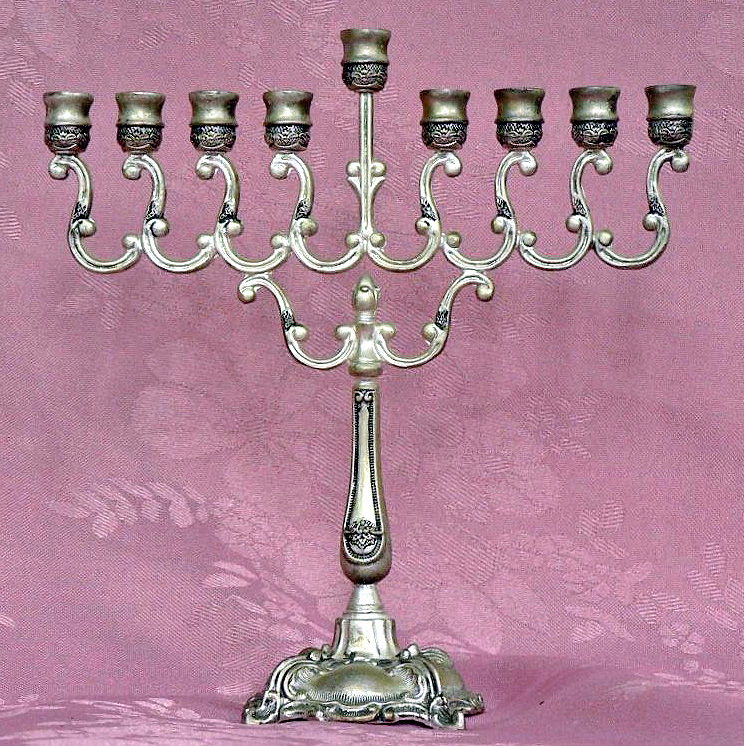
It's the last day of Chanukah, the night when the Chanukiah (see above) is filled with 8 candles plus the shamash (for details of the Shamash and other Chanukah FAQ, see this post)
This day is sometimes called 'Zot Chanukah' after part of the leining (Torah reading) for the day. Bemidbar/Numbers 7:84, after describing all of the gifts that the princes of each tribe gave for the inauguration of the Mishkan (the portable Shul used by the Children of Israel in the desert), says "this is the inauguration of the altar (Zot Chanukat hamizbayach) on the day that it was consecrated".
Curiously, the leining does not end with the details of the inauguration. Instead, it continues into the beginning of the next Sidra (Torah portion), called 'Beha'alotecha', which describes how Aharon HaCohen (Aaron, the high priest, brother of Moses) completed the daily routine of lighting the Menora in the Mishkan (the Menora was a 7 branched candelabra in the Mishkan, as opposed to the 8 branched Chanukiah that we use for Chanukah).
Rashi, the premier Torah commentator, explains that Aharon was upset. He wanted to show his dedication and gratitude to G-d but since he was not called to bring a large offering on behalf of
his tribe, he was worried that he was not a worthy representative since he was instead given the 'mundane' daily task of cleaning and lighting the Menora.
Rashi comments that G-d, noticing Aharon's upset, assured Aharon that Aharon's perception was wrong. Rather than being unworthy, Aharon was in fact honoured with the greatest task.
Rather than simply bringing offerings on a big, one-off occasion, Aharon was privileged to serve G-d every day in the Mishkan.
Consistency in a daily form is far more important than one-off events, however high profile they may be. Aharon, famed for loving and purusing peace (Pirkei Avot / Ethics of the Fathers 1:12) was so beloved by G-d, that G-d gave him the far greater task of lighting the Menora on a daily basis.
Ramban, another of the leading commentators, sees great historical significance in the Rabbis' decision to lein this story of Aharon on the last day of Chanukah. (Btw, the Torah reading calendar is of Rabbinic origin - why this is the case and why some Mitzvot can be of Rabbinic origin will be explored in future posts, all being well).
Ramban writes that the word Chanukat, as described above (it is the genitive form of Chanukah) is an allusion to the story of the Chashmonaim (Hasmoneans). The Chasmonaim were also Cohanim (priests) and thus descendents of Aharon. They were able to lead the Jewish people's fight for spiritual and political independence. In the footsteps of their ancestor Aharon, they were able to rekindle the lights and reinaugurate the Beit Hamikdash (Temple) just like Aharon played a crucial daily role in the inauguration and daily use of the Mishkan.
Conclusion
The Chashmonaim also show us that on Chanukah we do not simply celebrate a moment in time (like a balance sheet for the accountants reading). Rather, we celebrate and give thanks for a Chanukah time line which encompasses all of the salvations that our Chanukah prayers describe (a bit like the P&L for those accountants who are still reading and not fed up because they were looking for a break from accounts!).
Chanukah was not a 'one off' big event. It is a chag (festival) that celebrates all of the military, spiritual and political salvations of Chanukah.
Lighting candles to commemorate this reminds us of the lesson of Aharon Hacohen, that it is not one-0ff big events that are central to Judaism, but rather consistency every day (I guess you could say that Chanukah is not for Xmas, so to speak, lehavdil!) The lighting of the Chanukah candles reminds us not just of the miracle related to the oil but also of all of the Chanukah miracles and the daily consistency of being Jewish.
These are some of the reasons behind the choice of leining for Zot Chanukah.
Have a happy Zot Chanukah and enjoy the rest of the Chag.

Wednesday, 5 December 2007

(UPDATED!) Tein Tal U'Matar season starts with Maariv tonight, Weds 5 December 07

b

The Shulchan Aruch (Orach Chayim, 117:1) rules that in the 'Bar-aich Aleynu' beracha of the weekday Amida, there is a seasonal adjustment for winter. The phrase 'Ve-tain beracha' (and give blessing) is replaced with 'Ve-tain tal u'matar' (and give rain and blessing). For example, see page 218 in the green Siddur and page 270 in the Artscroll Siddur.
This of course is the source of the well worn joke, where a Yekke tells his wife that he will be home late from shul that night, due to the switch to Ve-tain tal u'matar!

Curiously, this adjustment is made according to a secular calendar to conincide with 60 days after the autumn equinox.

Why do we need to make this adjustment and why is it not based on the Jewish calendar?

The Talmud (Tractate Taanit 2a and other places in the first chapter) discusses when we should start praying for rain. For our purposes, this refers to what we say in the beracha of Bar-aich Aleynu. It does not refer to Mashiv Haruach umorid hagashem which is praise of G-d, not a request for rain, as evidenced by its placement in the first section of the Amida which deals solely with praise.

According to the Talmud (Taanit 10a), the prayer for rain is seasonal and therefore different customs arose in Israel and the Diaspora (for our purposes, the Diaspora means Babylon). In Israel, the switch ve-tein tal umatar is always made according to the Jewish calendar, on 7 Cheshvan. This suits the needs of the Land of Israel and in Temple times allowed pilgrims time to get home from Jerusalem to other parts of Israel without praying for themselves to get soaked on the way!

By contrast, Babylon was run according to a different calendar. The optimum time for rain in Babylon was 60 days after Tekufat Tishrei (the autumnal equixox - this is one for calendar lovers) and so the Halacha as applied in Babylon meant that was the time to start saying Tein Tal Umatar. Since the Babylonians did not use a Jewish calendar but used a calendar more similar to the Gregorian calendar we, who in the Diaspora are considered like the Babylonians for this purpose, follow the 60th day after the autumnal equinox which currently falls on 4 or 5 December depending on the year.

The ruling of the Shulchan Aruch, mentioned at the top, is based on the Rambam, Hilchot Tefila 2:16. In addition, the Beit Yosef, initially citing the ruling of the Rosh (Responsa 4:10), confirms after some lengthy discussion that Babylonian practice is applicable to the rest of the Diaspora as well.

For those who like the maths behind it, I am indebted to Philip Baigel and Russell Grossman of the Yeshurun Shul in Edgware for their mathematical explanation on Yeshurun's website:
Tal Umatar Has Started!
"We started saying Tal Umatar from the evening of 5th December in the weekday Amidah, 60 days after an event known as Tekufat Tishrei - the first day of the Autumn season, which starts on the 23rd September. This is when the area of Babylonian exile, roughly modern day Iraq and representing the diaspora, needed rain. Sixty days after 23rd September is November 21st. But we don't say Tal Umatar until the 4th of December because the calculation was originally based on a solar year of 365.25 days. We now know the solar calendar is 365.2425 days and this discrepancy of 11 minutes and 14 seconds means the Tekufah has moved forward at a rate of one day every 128 years.
By 1582 the discrepancy had reached 10 days. The Catholics, led by Pope Gregory XIII (that's him pictured [on the Yeshurn site], looks like a frum bloke) decided to drop the extra ten days from the then Julian calendar by making the day after Thursday, October 4, 1582 Friday October 15, in a new calendar named “Gregorian” in the Pope's honour. As a result the day which would have been September 23 according to the Julian calendar is October 7 of the Gregorian The 60th day following which is December 5. Since we begin Tal Umatar during Maariv, that's the night of December 4. Every fourth year, however the Tekufah begins after the time that stars are visible ('Tzeit hakochavim') on October 7. The 60th day on those years is therefore December 6, and Tal Umotor begins on the evening of December 5."


This works well for us Northern Hemisphere guys but what about countries in the Southern Hemisphere or those close to the Equator? One posek who dealt with this question was the famed Rabbi Shmuel Salant, (1816-1909)for many years the Rav of Jerusalem (not in the 'English' meaning recorded by Wikipedia!).

In 1898, R'Avraham Avar Hirshovitz, perhaps a student of Rabbi Salant, sent a question from Melbourne asking whether Tein tal umatar should be recited in Australia from 4/5 December, a time which is the middle of the Australian summer. Interestingly, R'Hirshovitz was not the only Aussie petitioner to approach Rabbi Salant (see Torat Rabeinu Shmuel Salant 1:3)

Chief Rabbi Nathan Marcus Adler of London had already ruled that the Jews of Australia should say Tein Tal Umatar, presumbaly for the reasons we outlined above. R'Hirshovitz demured but Rabbi Salant replied that Rabbi Adler had authority to make this ruling and that R'Hirshovitz should follow Rabbi Adler's ruling.

Got that one you Aussies!! No flippers!

Conclusion
The Diaspora follows the custom of Babylon, unifying the Diaspora.

Tuesday, 4 December 2007

Chanukah Prayers - Why do we say Al Hanisim and Bi'mei Matityahu?

Whilst Maoz Tzur may be the best known Chanukah song, the prayers of 'Al Hanisim' and 'Bi'mei Matityahu' (from now, I'll refer to both by just 'Al Hanisim') are inserted into every Amida prayer (not to be confused with this even if you go there more often than you pray) and also Birkat Hamazon on Chanukah. Let us take a brief look at these prayers and why. You can find Al Hanisim at the foot of page 90 in the green Siddur and the foot of page 112 in the Artscroll Siddur.


The Talmud (Tractate Shabbat 21b) gives a very brief explanation of the nuts and bolts of some of the Chanukah story. It concludes the explanation by stating that the Rabbis instituted Chanukah as days of hallel ve'hoda'ah (praise and thanks). Rashi writes that the Rabbis did not prohibit any melacha on these days but instead ruled that we should recite Hallel and say Al Hanisim in the 'Hoda'ah' (Modim) section of the Amida.


A little later (page 24a), the Talmud discusses reciting something to do with Chanukah in Birkat Hamazon during Chanukah. Rashi there references us back to page 21b so that we can assume that the discussion regarding Birkat Hamazon also refers to Al Hanisim.


The Talmud states that the reason for reciting Al Hanisim in these prayers is due to the major theme of Chanukah being to thank G-d for all of the Chanukah miracles (at last we may come closer to answering what exactly those miracles were as we've been discussing in Shul). That is why it is placed in the beracha (blessing) of Modim and also in the second beracha in Birkat Hamazon thanking G-d for the Land of Israel.


Therefore, it seems that Rashi on 21b states that Al Hanisim is part of the institution of Chanukah just like lighting candles (but not like eating sufganiyot - that's Hebrew for doughnuts - as we discussed in the previous Chanukah post. I hope you are enjoying the olive oil drizzled on your salad!)


However...it is noteworthy that Rambam appears to disagree. In his great legal magnum opus, Mishnah Torah, the order of the material is a good clue to the Rambam's opinion. Where does he quote the halacha of Al Hanisim? Hands up if you think it is in the Laws of Chanukah...


...well done for keeping that hand down! Interestingly, Rambam instead references Al Hanisim in the Laws of Tefilah (Prayer) 2:13, which we studied in Shul on Shabbat afternoons and also in the Laws of Berachot (benedictions - great word) 2:6.

This codification suggests that Rambam sees Al Hanisim as part of the general structure of thanks in prayer rather than a specific Chanukah institution such as kindling lights.


Tosafot ('Mahu' and 'Mazkir', 24a) appears to demur. In the first comment, Tosafot once again presents the opinion, as attendees at the Wednesday night Talmud class will know, that the main motivation for mentioning Chanukah is to publicise the Chanukah miracles.

In the second comment, Tosafot differs from our presentation of Rambam's position by writing that Al Hanisim is specific thanks to G-d for Chanukah and not part of the general message of thanking G-d in prayer.

Perhaps we can refine our understanding by reviewing the actual text of Al Hanissim. Here is Chief Rabbi Sacks' translation:
"[We thank You also] for the miracles, the redemption, the mighty deeds, and the victories in battle which You performed for our ancestors in those days at this time.

In the days of Mattityahu, son of Yochanan the High Priest, the Hasmonean, and his sons, the wicked Greek kingdom rise up against Your people Israel to make them forget Your Torah and to force them to transgress the statutes of Your will. It was then that You in Your great compassion stood by them in the time of their distress. You championed their cause, judged their claim, and avenged their wrong. You delivered the strong into the hands of the weak, the many into the hands of the few, the impure into the hands of the pure, the wicked into the hands of the righteous, and the arrogant into the hands of those who were engaged in the study of Your Torah. You made for Yourself great and holy renown in Your world, and for Your people Israel You performed a great slavation and redemption on this day. Your children then entered the holiest part of Your house, cleansed Your Temple, purified Your sanctuary, kindled lights in Your holy courts, and designated these eight days of Chanukah for giving thanks and praise to Your great Name."

What is the main theme of this prayer? To me, it seems like it is the military victory and salvation of the Jewish people, along with the rededication of the Beit Hamikdash (Temple). The kindling of lights is mentioned right at the end, seemingly only in connection with the service in the Temple and not in connection with a particular miracle of a light that lasted for eight days.

In fact, the commentary of the Maharsha to Shabbat 21b suggests that the rededication of the Temple is the main celebration of Chanukah.

For a fascinating discussion of the some of these possibilites, see Rabbi Menachem Leibtag's essay on Chanukah which I would strongly recommend that you read.

Conclusion
We have seen some of the background to Al Hanisim. Perhaps its placement in both the Amida and Birkat Hamazon is to inform us that we should be grateful to G-d for saving us on Chanukah as part of our general thanks to G-d. However, it may also inspire us to consider that the specific thanks of Chanukah which are not just limited to physical salvation but also to the fact that we could rededicate the Beit Hamikdash and our continue to live and develop as Jews with Judaism rather than Jews with those aspects of Hellenism which were antithetical to Judaism.

This may explain the differing approaches to Al Hanisim amongst the Rishonim cited above. For Rambam, Al Hanisim is part of the general laws of prayer since it must be placed in the 'thank you' section of the Amida. It is also placed in a similar section of Birkat Hamazon, describing our thanks for the Land of Israel.

For Rashi, Al Hanisim is specifically part of the mitzvot of Chanukah, just like lighting candles.

Both of these approaches should help us enhance our appreciation and enjoyment of Chanukah.

Chanukah Samayach - Happy Chanukah.

Monday, 3 December 2007

Chanukah FAQ...FGA


Chanukah this year (5768 Jewish year, 2007 secular year) starts on Tuesday night 4 December. Here are some FAQ...and FGA (frequently given answers!) References are to chapter and ver...paragraph in the Shulchan Aruch (also see here) and Rema, section "Orach Chayim" plus other sources which are indicated on the spot.

Here is a summary of the Chanukah story.
---
How do you spell Chanukah in English?! - did I just spell it right!
Chanukah is of course a Hebrew word. Since we sometimes need to transliterate Hebrew words into English, we need to find the right characters in the English language. Since Hebrew, like many other languages, has different dialects and pronounciations (well, e ba gum eh!) it can be transliterated in different ways. Personally, I go for Chanukah.


The best way to read it is obviously in Hebrew. Take a look at the Hebrew alphabet and how to pronounce it. If you want to learn how to read Hebrew or you want to brush up your reading, please email me to arrange some practice or for MP3 recordings of some of the major prayers.

What should I eat for Chanukah?
Well, far be it from me to offer nutritonal or culinary advice (unless we are talking this, of course and this in particular). Whilst there is no requirement to have sit down celebratory Chanukah meal (unlike Purim), since one of the Chanukah miracles was performed with oil, the custom arose to eat oily foods. Latkes and doughnuts are often trumpeted as favourites - look out for Israeli news stories about the biggest number of sufganiyot (doughnuts) to be baked in the Middle East etc.) but Rema (670:2) mentions cheese as another option to commemorate the heroine Yehudit who used cheese to complete her mission.

Although far be it from me to offer nutritional advice, you do not have to eat any of these fatty foods and may simply prefer to garnish your salad with olive oil (all pure olive oils are kosher).

Betayavon/bon appetit!

How many candles should I light?
You should light one candle per night, plus an extra candle called a shamash (671:5). Use the shamash for lighting the other candles. The first time that you light the candles, 3 berachot (blessings) are recited. Subsequently, you just say the first two. You can find the berachot and explanations in the green Siddur on page 732 and in the Artscroll Siddur on page 782.

What order should I light in?
When facing the Chanukiah (Chanukah candelabra), load the candles from the right of the Chanukiah. Each night, add a candle to the left and light the 'newest' candle first, then moving to the right (yes, religiously as well - ho ho ho).

How many Chanukiot (pl.) do we light and what if I am prevented from lighting a Chanukiah?
You can light one Chanukiah per household or each individual can light one Chanukiah for themselves. If one member of the household is unable to be present for the lighting of the candles and is unable to light candles for themselves afterwards (eg if you are a doctor working a shift that precludes you from lighting candles) then you should appoint another member of your household to act as your agent.

What if I do not have a Chanukiah?
You do not need a 'special' Chanukiah. You can use any candles, such as tea lights resting on an appropriate fire resistant surface. Just make sure that the candles are in a straight line (671:4) to make sure that each candle is distinct.

Where should I light the candles?
Ideally, the candles should be lit by a window facing the street. Otherwise, if you live in a flat with no window facing street level, light the candles in a place where the family or household members will see them.


What can I use for Chanukiah lights?
If you do not use candles, use olive oil (673:1).

What about electirc lights? Rabbi Ovadia Yosef, a former Chief Rabbi of Israel, was presented with this question. In his work, "Yechaveh Da'at" (4:202) Basing his answer on the primary sources in the Talmud and subsequent judicial opinion, he ruled that electric lights do not work for Chanukah.

Have I performed the Mitzva of lighting Chanukah lights if I go to a friend's house or a public lighting such as at shul?
Chanukah lights are kindled per household so you need to light them at home or at the place where you are staying if you are away from home. (671:7)


When should I light the Chanukah candles?
The earliest time is called Pelag Hamincha. In London during Chanukah, this is at approximately 3.10pm. The ideal time is at nightfall (the time when Shabbat goes out for Shabbat at the end of that week). Otherwise the Chanukah lights can be lit later on at night when you come home. Try to make sure that either somebody else in the house is up when you light or that you light before midnight i.e a time when people are still on the streets.

If it later than this when you get home and nobody else is awake at home, then light the candles without the berachot. Email me if you want to know why.


How long should the lights last for?
The Chanukah lights need to burn for at least half an hour during dark.


Can I use the Chanukah lights for anything else?
No! Light them, look at them and contemplate the Chanukah miracles. As we sing in the haneirot halalu, one of the Chanukah songs, the lights are solely for the purpose of the mitzva of Chanukah lights and not for any other purpose.


What should I do on the Friday of Chanukah?
On Friday, light the Chanukah candles before the Shabbat candles. This year (December 2007), the earliest time (pelag hamincha) in London for lighting the candles is 3.10pm and Shabbat comes in at 3.37pm. Once you have lit the Chanukah candles, then light Shabbat candles. If you have not lit before Shabbat comes in then you should neither light Shabbat nor Chanukah candles once Shabbat has started.

Since the Chanukah lights need to burn for at least half an hour during dark, make sure that use big enough candles. Tea lights are particularly good for this purpose.

What should I do after Shabbat?
At home, you should make Havdala first and then light Chanukah candles.

The only exceptions are if: 1. you have already said 'Ata Chonantanu' in the Maariv amida, 2. heard Havdala in Shul or 3. said the phrase 'Baruch Hamavdil bein Kodesh lechol'. See 681:2


What should I do if I am guest at somebody else's house?
Either you should light your own Chanukah lights or give your host some coins to show that you are a partner in his or her lighting.

Can a child light the Chanukah candles?
A child (ie girl under 12, boy under 13) can light their own Chanukah candles but a child should neither say berachot nor light on behalf of an adult (ie boy above 13, girl above 12).

Are there any special prayers for Chanukah?
Hallel is said each day of Chanukah. The paragraphs of Al Hanisim and Bimay Matityahu are added into the Amida prayers on Chanukah. The Torah is also read each day of Chanukah. Psalm 30 is recited when the Chanukiah is lit in Shul.

The most famous Chanukah song is 'Maoz Tzur'. To check it and other Chanukah songs out click here but not here.

Do I have to play with a dreidl?
Only if you like to or have run out of other things to do...!

Chanukah Samayach / Happy Chanukah to all.

Where to buy Kosher Food Locally and Internet Kosher Shopping


The South Hampstead area is well served by kosher shops. Here is a smorgasboard, so to speak!!

Just Kosher is an online Kosher supermarket. It's just like ordering from Tesco, Sainsbury, Ocado etc.

Adafina is a deli and grocery shop based in St John's Wood. It also offers Internet ordering and delivery.

Sainsbury's supermarket in the O2 centre stocks a range of kosher fridge, frozen and other goods including kosher bread and kosher chalot from Sharon's bakery (this is not run out of my kitchen, thankfully). Please note that the supermarket own brand chalot are not kosher.

Waitrose by Finchley Road Station, Morrison's in Chalk Farm and Budgens by Belsize Park Station also have some kosher food.

Always check that the food actually is Kosher! The word 'Kosher' is unfortuantely no guarantee that the food actually is Kosher - although it is kind of funny that unscrupulous people may think they can make money by passing off bacon as kosher, to use an extreme example!
Look for the hechsher (sign certifying that the food is kosher).

For more Kosher information and for lists of kosher food, go to the London Beit Din's Kashrut Department at the Office of the Chief Rabbi.

Kashrut (keeping kosher) is good for the soul and not just a question of how many different flavour types of this that I can go for! (check which ones are Kosher looking for the logo above!)

Whilst this post explains practically how to find kosher food, we will examine some of the meanings behind Kashrut in later posts.

Betayavon / Bon Appetit.

Thursday, 29 November 2007

An evening with Howard Jacobson, interviewed by Rabbi Shlomo Levin

How is one to convey news of the arrival of a work of genius? . . . It is the most intelligent and important novel [in years] . . . It is, to repeat and to repeat plainly, a work of genius." - A. C. Grayling, The Times on Kalooki Nights

Howard Jacobson is Britain’s greatest Jewish novelist, whose latest outstandingly brilliant novel “Kalooki Nights”, recently won the Jewish Quarterly Wingate Prize 2007.

Here’s your chance to hear him discuss Jewishness, literature and comedy in his inimitable witty style.
Details: Sunday, 2 December 2007, 8:00 – 9:30pm, £10 per person, Refreshments, Book signing session.
Reserve your place in advance by emailing Diane.